One of the most important changes introduced by AI is the shift from reactive to predictive monitoring.
- Detects problems after they have already occurred
- Relies on static thresholds
- Reacts to visible symptoms
- Analyzes historical patterns
- Detects early anomalies
- Anticipates future incidents
Thanks to AI, monitoring stops being a tool for “putting out fires” and becomes an active prevention system.
The real value of AI-powered monitoring lies in its ability to think in terms of systems, not isolated metrics.
AI observes how services behave across different scenarios:
- Peak hours vs off-peak hours
- Normal days vs large-scale events
- Version changes
- Geographic regions
- User types
Over time, it builds a dynamic model of normal behavior. This makes it possible to detect deviations that a human would hardly notice.
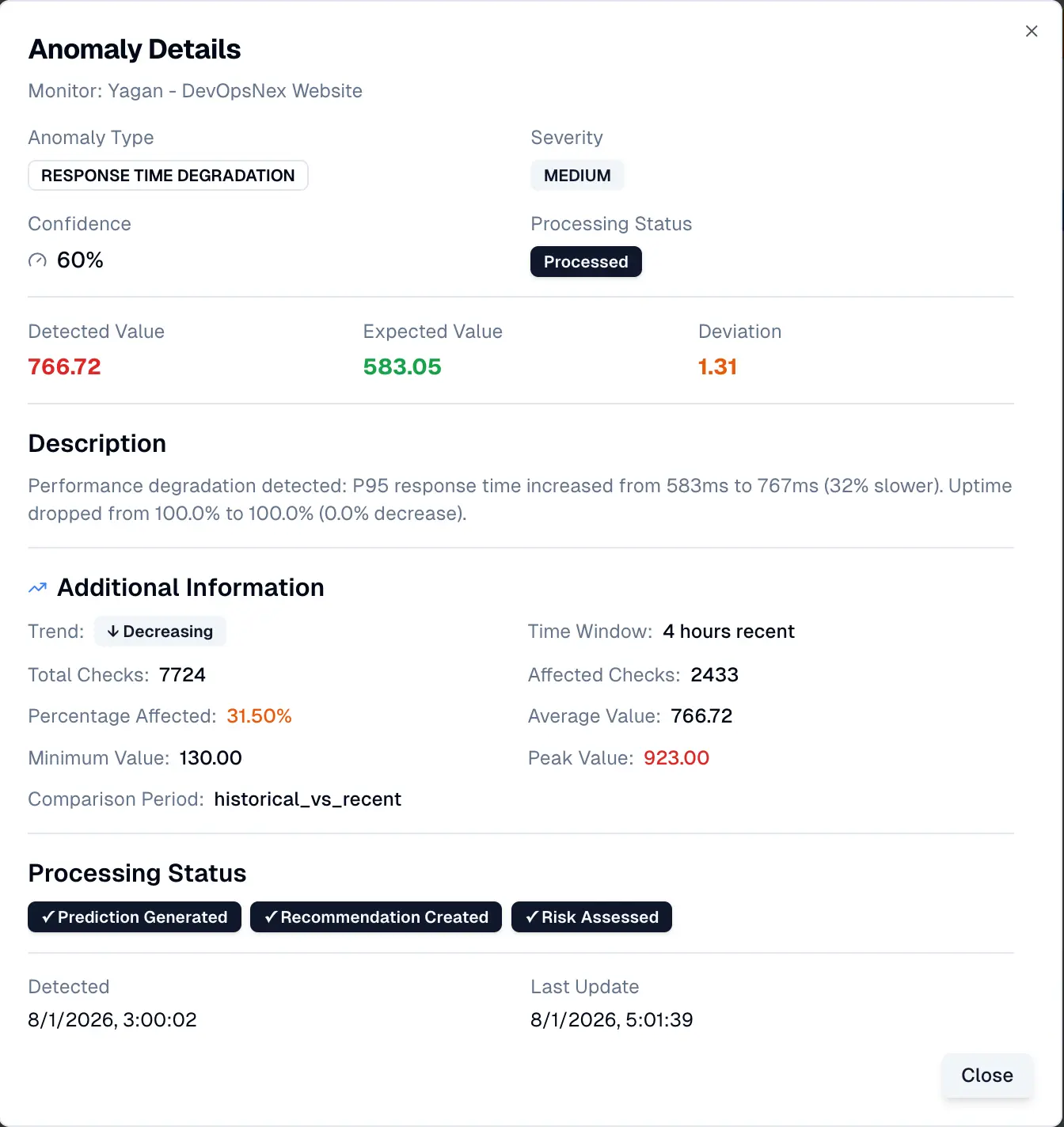
Anomaly detection is one of the most visible applications of AI-powered monitoring.
Instead of triggering alerts when a metric crosses a fixed value, AI identifies unusual behaviors such as:
- Gradually increasing latencies
- Intermittent errors
- Atypical traffic patterns
- Subtle changes in response times
Many major outages start this way: with small signals that go unnoticed. AI makes it possible to see them in time.
Another radical change introduced by AI is automatic event correlation.
In traditional monitoring, each alert is treated as an independent event. This generates noise and confusion. AI-powered monitoring groups related signals and answers key questions:
- What happened first?
- Which services are related?
- Which alerts are causes and which are effects?
This correlation drastically reduces alert fatigue and accelerates incident diagnosis.
Root Cause Analysis (RCA) is one of the most complex tasks in operations. AI fundamentally changes this process.
Instead of manual investigation, AI:
- Analyzes metrics, events, and anomalies together
- Compares current incidents with historical ones
- Identifies recurring patterns
- Suggests the most likely root cause
This turns AI-powered monitoring into an active assistant during incidents, not just an alerting system. As a result, it is not only faster, but it also allows engineers to focus on fixing issues rather than investigating them.
Modern architectures do not fail in isolation. Problems often propagate across services.
AI is especially well suited to handle this complexity because it:
- Analyzes relationships between components
- Understands implicit dependencies
- Learns how end-to-end flows behave
- Identifies systemic bottlenecks
This makes AI-powered monitoring especially valuable for microservices, multicloud environments, and platforms with multiple integrations.
Adopting AI in monitoring has a clear impact on critical metrics.
Early detection and assisted diagnosis speed up recovery.
Problems are detected before users report them.
Less degradation time translates into higher real availability.
Prevention replaces late reaction.
These improvements are not theoretical; they are observable results in teams that adopt AI-powered monitoring.
One of the biggest shifts is the focus on real user experience.
AI makes it possible to monitor:
- Complete login, purchase, or payment flows
- Simulated user behavior
- End-to-end experience, not just individual components
By monitoring complete flows (login, purchase), AI helps directly link technical health with revenue or customer churn.
This directly connects monitoring with business indicators such as conversion, retention, and customer satisfaction.
A common fear is that AI will replace engineers. In practice, the opposite happens.
AI-powered monitoring:
- Reduces repetitive work
- Eliminates unnecessary noise
- Provides context and clarity
- Enables better-informed decisions
Teams stop constantly reacting and can focus on improving architecture, resilience, and innovation.
UptimeBolt was built under the AI-powered monitoring paradigm from the ground up, not as an afterthought.
Its approach combines:
- AI-based anomaly detection
- Incident prediction
- Intelligent event correlation
- Assisted root cause analysis
- End-to-end flow monitoring
- Contextual and actionable alerts
All of this enables a shift from reactive monitoring to a preventive, predictive, and business-oriented model.
If you want to experience how AI-powered monitoring can help you anticipate incidents and reduce operational impact, sign up and get a free trial.
Monitoring is no longer a passive activity; it is becoming an intelligent system that learns, predicts, and recommends actions. Artificial intelligence is not a luxury or a passing trend—it is the natural response to the current complexity of digital systems.
In the coming years, organizations that continue to rely solely on traditional monitoring will always be reacting too late. Those that adopt AI-powered monitoring will operate with an advantage, fewer incidents, and greater stability.
The question is no longer whether AI will change monitoring.
The question is when you will start using it to your advantage.

From Reactive Monitoring to Predictive Monitoring
One of the most important changes introduced by AI is the shift from reactive to predictive monitoring.
Reactive monitoring
AI-powered monitoring
Thanks to AI, monitoring stops being a tool for “putting out fires” and becomes an active prevention system.
Artificial intelligence as the brain of modern monitoring
The real value of AI-powered monitoring lies in its ability to think in terms of systems, not isolated metrics.
Learning normal behavior
AI observes how services behave across different scenarios:
Over time, it builds a dynamic model of normal behavior. This makes it possible to detect deviations that a human would hardly notice.
Anomaly detection: the first major leap
Anomaly detection is one of the most visible applications of AI-powered monitoring.
Instead of triggering alerts when a metric crosses a fixed value, AI identifies unusual behaviors such as:
Many major outages start this way: with small signals that go unnoticed. AI makes it possible to see them in time.
Intelligent event correlation: less noise, more clarity
Another radical change introduced by AI is automatic event correlation.
In traditional monitoring, each alert is treated as an independent event. This generates noise and confusion. AI-powered monitoring groups related signals and answers key questions:
This correlation drastically reduces alert fatigue and accelerates incident diagnosis.
AI-assisted Root Cause Analysis
Root Cause Analysis (RCA) is one of the most complex tasks in operations. AI fundamentally changes this process.
Instead of manual investigation, AI:
This turns AI-powered monitoring into an active assistant during incidents, not just an alerting system. As a result, it is not only faster, but it also allows engineers to focus on fixing issues rather than investigating them.
How AI understands complex and distributed systems
Modern architectures do not fail in isolation. Problems often propagate across services.
AI is especially well suited to handle this complexity because it:
This makes AI-powered monitoring especially valuable for microservices, multicloud environments, and platforms with multiple integrations.
Direct impact on key operational metrics
Adopting AI in monitoring has a clear impact on critical metrics.
Reduced MTTR
Early detection and assisted diagnosis speed up recovery.
Improved MTTD
Problems are detected before users report them.
Better SLA compliance
Less degradation time translates into higher real availability.
Less downtime
Prevention replaces late reaction.
These improvements are not theoretical; they are observable results in teams that adopt AI-powered monitoring.
AI-powered monitoring and user experience
One of the biggest shifts is the focus on real user experience.
AI makes it possible to monitor:
By monitoring complete flows (login, purchase), AI helps directly link technical health with revenue or customer churn.
This directly connects monitoring with business indicators such as conversion, retention, and customer satisfaction.
Why AI doesn’t replace teams — it empowers them
A common fear is that AI will replace engineers. In practice, the opposite happens.
AI-powered monitoring:
Teams stop constantly reacting and can focus on improving architecture, resilience, and innovation.
How UptimeBolt represents this new generation of monitoring
UptimeBolt was built under the AI-powered monitoring paradigm from the ground up, not as an afterthought.
Its approach combines:
All of this enables a shift from reactive monitoring to a preventive, predictive, and business-oriented model.
If you want to experience how AI-powered monitoring can help you anticipate incidents and reduce operational impact, sign up and get a free trial.
Conclusion: the future is preventive, not reactive
Monitoring is no longer a passive activity; it is becoming an intelligent system that learns, predicts, and recommends actions. Artificial intelligence is not a luxury or a passing trend—it is the natural response to the current complexity of digital systems.
In the coming years, organizations that continue to rely solely on traditional monitoring will always be reacting too late. Those that adopt AI-powered monitoring will operate with an advantage, fewer incidents, and greater stability.
The question is no longer whether AI will change monitoring.
The question is when you will start using it to your advantage.