User flow simulation is one of the most effective —and least leveraged— practices for protecting revenue in high-risk digital platforms such as e-commerce, marketplaces, and transactional applications. In high-traffic environments, a silent 1% failure in checkout can easily translate into tens of thousands of dollars lost per day, even when the site appears to be “up.”
In many cases, systems do not go completely down: critical flows fail silently, without clear alerts, while revenue is lost in the background. Logins that never complete, carts that fail to load properly, payments that break only under certain conditions, or confirmations that never arrive are issues that traditional monitoring struggles to detect.
This is where advanced critical flow simulation, based on synthetic monitoring, becomes essential to validate the real behavior of the system before users are affected and the impact reaches revenue, conversion, and customer experience.
In this article, we explain how user flow simulation works, which errors it detects, why it is critical for e-commerce, and how it directly impacts conversion, sales, and operational reliability.
One of the biggest risks in modern digital systems is assuming that “if the site is up, everything works.” In practice, this is rarely true.
Critical flows often fail due to issues such as:
- Small frontend changes that break forms
- JavaScript errors that only appear in specific steps
- Performance degradation in microservices or third-party APIs (soft timeouts), where the system returns
200 OK but with latencies high enough to break the UX
- Intermittent payment integrations
- Inconsistent session states
- Misconfigured redirects
These problems do not always trigger infrastructure alerts or clear HTTP errors. Without user flow simulation, they can remain undetected for hours or days — usually when the impact on revenue is already significant.
User flow simulation is an active monitoring technique that automatically and repeatedly executes complete sequences of actions that a real user would perform within a platform.
It is important to clarify a key point:
User flow simulation does not measure real user behavior (that is the role of RUM). Instead, it validates the real behavior of the system by simulating users in a controlled, repeatable, and continuous way.
These simulations typically include:
- Page navigation
- Form interactions
- Data submission
- Response validation
- Timing and error measurement
By running continuously, they confirm that the system continues to work correctly even when there is no real user traffic at that moment.
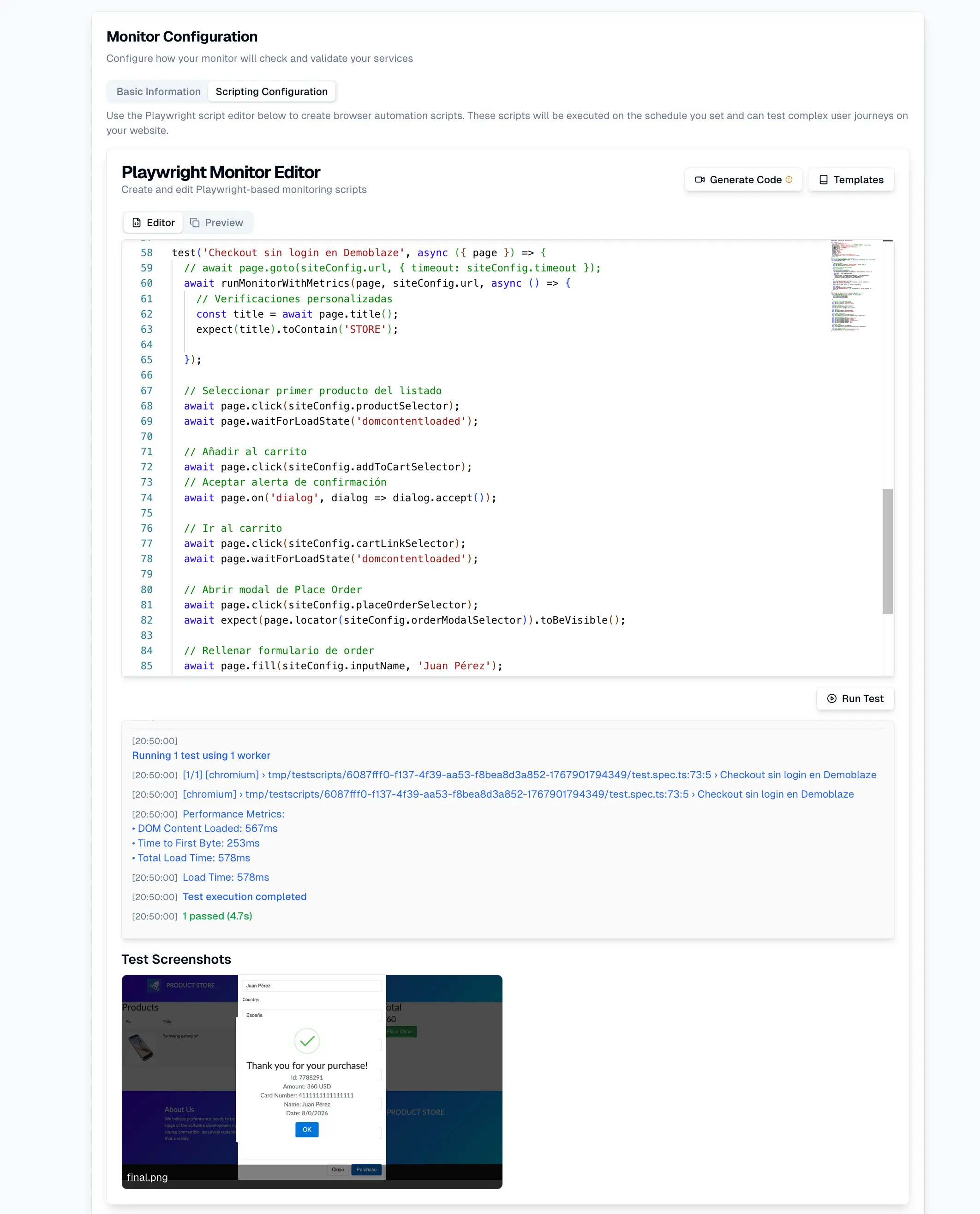
An E2E simulation does not test isolated components. It tests the system as a whole.
A typical flow looks like this:
- Initial access to the platform
- Login with valid credentials
- Navigation to a specific section
- Execution of a critical action (add to cart, pay, confirm)
- Validation of the expected outcome
If any step fails, it is detected immediately — even if the rest of the system appears operational.
In transactional platforms, certain flows concentrate most of the risk and economic value.
If login fails, nothing else matters. Common issues include:
- Poor token handling
- Session expiration problems
- Changes in identity providers
User flow simulation ensures that access works consistently.
Carts are often affected by:
- Frontend changes
- Cache issues
- Synchronization errors
An E2E simulation confirms that products are added, persisted, and displayed correctly.
Checkout is the most critical point in e-commerce. Multiple systems converge here: frontend, backend, inventory, promotions, and taxes.
Advanced simulation detects:
- Broken forms
- Incorrect calculations
- Validations that block the flow
Example: a change in a tax or shipping provider that only fails when the cart contains more than 10 items, returning a 500 error that the frontend silently hides.
Payments often fail intermittently due to:
- Slow external APIs
- Network issues
- Unhandled timeouts
An E2E simulation validates that the payment is processed correctly and that the system responds properly under different scenarios.
Even if payment succeeds, the flow can break during confirmation:
- Pages that fail to load
- Emails that are not sent
- Inconsistent states
Detecting these issues is essential to prevent complaints and loss of trust.
User flow simulation uncovers issues that other approaches miss, such as:
- Logical errors without technical failures
- Order-dependent failures
- Issues that occur only under specific conditions
- Progressive performance degradation
- “Minor” changes that break entire flows
That is why relying only on infrastructure or API monitoring leaves dangerous blind spots.
A system can have 99% log availability, while E2E simulations reveal that 10% of users cannot complete payment due to a logical error that is never logged.
Every failure in a critical flow directly impacts business metrics.
Without user flow simulation:
- Cart abandonment increases with no clear cause
- Conversions decline gradually
- Teams react too late
- Revenue is lost without knowing exactly why
With E2E simulation:
- Errors are detected earlier
- Issues are fixed before users are affected
- Experience remains consistent
- Conversion metrics stabilize
In e-commerce, validating critical flows means protecting revenue.
Although often confused, they are not the same.
Automated tests:
- Run in CI/CD
- Validate code before deployment
- Do not test real production conditions
User flow simulation:
- Runs continuously
- Validates the system in real environments
- Detects operational and integration issues
Both approaches complement each other, but E2E simulation fills the gap between “the code works” and “the business works.”
Advanced simulation is especially critical in:
- E-commerce during major traffic events
- Marketplaces with multiple sellers
- Subscription platforms
- Systems with external payment integrations
- Applications with frequent releases
In these environments, a silent error can represent massive losses in a very short time.
UptimeBolt enables the creation and execution of advanced critical flow simulations by combining synthetic monitoring with artificial intelligence.
The platform provides:
- Simulation of login, cart, checkout, and payment flows
- Continuous execution from multiple locations
- Timing measurement and result validation
- Anomaly detection in E2E flows
- Correlation with metrics and events
- Prediction of flows at risk before they fail
AI-driven flow simulation relies on three main technical capabilities:
The system analyzes how flows such as login, checkout, or payment behave under different conditions:
- Varying traffic levels
- Hourly and seasonal patterns
- Recent code or configuration changes
- External dependencies (payments, authentication, third-party APIs)
From this history, AI builds a dynamic baseline of normal behavior instead of relying on static thresholds.
Rather than alerting only when a flow completely fails, AI detects progressive deviations that indicate risk:
- Gradual increase in total flow duration
- Accumulated latency in specific steps (e.g., payment validation)
- Abnormal increases in retries or timeouts
- Subtle drops in success rate, even when still “acceptable”
This makes it possible to identify flows at risk of failing, not just flows that have already failed.
Prediction is not based solely on synthetic flow results. AI correlates them with:
- Infrastructure and application metrics
- Recent events (deployments, configuration changes)
- Behavior of APIs and external dependencies
This allows teams to understand which step is degrading and why, before users are impacted.
In this approach, AI does not replace the intentional design of critical flows, which remains a team decision (what to simulate and why).
Its value lies in making those flows intelligent once defined:
- Learning how they should behave
- Adapting to real system changes
- Anticipating failures without manual rule or threshold tuning
Thanks to historical learning, dynamic thresholds, and contextual correlation, flow simulation evolves from a periodic test into a predictive operational tool.
Instead of discovering that checkout is already broken, teams can know which flow is entering a risk zone, with enough lead time to act before revenue is lost or user experience degrades.
If you want to validate your critical flows and protect your revenue with advanced simulation, sign up and get a free trial.
In modern digital systems, the most costly errors are not always obvious. They often hide in critical flows that fail silently while the site appears operational.
User flow simulation makes it possible to detect these issues before they impact conversion, sales, and customer trust. By continuously validating login, cart, checkout, and payment flows, organizations move from reacting to incidents to preventing real revenue loss.
In e-commerce and transactional platforms, monitoring infrastructure alone is no longer enough.
Validating critical flows is protecting the business.

User flow simulation is one of the most effective —and least leveraged— practices for protecting revenue in high-risk digital platforms such as e-commerce, marketplaces, and transactional applications. In high-traffic environments, a silent 1% failure in checkout can easily translate into tens of thousands of dollars lost per day, even when the site appears to be “up.”
In many cases, systems do not go completely down: critical flows fail silently, without clear alerts, while revenue is lost in the background. Logins that never complete, carts that fail to load properly, payments that break only under certain conditions, or confirmations that never arrive are issues that traditional monitoring struggles to detect.
This is where advanced critical flow simulation, based on synthetic monitoring, becomes essential to validate the real behavior of the system before users are affected and the impact reaches revenue, conversion, and customer experience.
In this article, we explain how user flow simulation works, which errors it detects, why it is critical for e-commerce, and how it directly impacts conversion, sales, and operational reliability.
Why critical flows fail without anyone noticing
One of the biggest risks in modern digital systems is assuming that “if the site is up, everything works.” In practice, this is rarely true.
Critical flows often fail due to issues such as:
200 OKbut with latencies high enough to break the UXThese problems do not always trigger infrastructure alerts or clear HTTP errors. Without user flow simulation, they can remain undetected for hours or days — usually when the impact on revenue is already significant.
What is user flow simulation and how does it work?
User flow simulation is an active monitoring technique that automatically and repeatedly executes complete sequences of actions that a real user would perform within a platform.
It is important to clarify a key point:
These simulations typically include:
By running continuously, they confirm that the system continues to work correctly even when there is no real user traffic at that moment.
How an E2E (end-to-end) simulation works
An E2E simulation does not test isolated components. It tests the system as a whole.
A typical flow looks like this:
If any step fails, it is detected immediately — even if the rest of the system appears operational.
Key critical flow simulation scenarios
In transactional platforms, certain flows concentrate most of the risk and economic value.
Login and authentication
If login fails, nothing else matters. Common issues include:
User flow simulation ensures that access works consistently.
Shopping cart
Carts are often affected by:
An E2E simulation confirms that products are added, persisted, and displayed correctly.
Checkout
Checkout is the most critical point in e-commerce. Multiple systems converge here: frontend, backend, inventory, promotions, and taxes.
Advanced simulation detects:
Example: a change in a tax or shipping provider that only fails when the cart contains more than 10 items, returning a 500 error that the frontend silently hides.
Payment processes
Payments often fail intermittently due to:
An E2E simulation validates that the payment is processed correctly and that the system responds properly under different scenarios.
Order confirmation and post-transaction flows
Even if payment succeeds, the flow can break during confirmation:
Detecting these issues is essential to prevent complaints and loss of trust.
Invisible errors that only E2E simulation detects
User flow simulation uncovers issues that other approaches miss, such as:
That is why relying only on infrastructure or API monitoring leaves dangerous blind spots.
Direct impact on sales, conversion, and cart abandonment
Every failure in a critical flow directly impacts business metrics.
Without user flow simulation:
With E2E simulation:
In e-commerce, validating critical flows means protecting revenue.
Flow simulation vs traditional automated testing
Although often confused, they are not the same.
Automated tests:
User flow simulation:
Both approaches complement each other, but E2E simulation fills the gap between “the code works” and “the business works.”
Flow simulation in high-risk contexts
Advanced simulation is especially critical in:
In these environments, a silent error can represent massive losses in a very short time.
How UptimeBolt runs intelligent flows with AI
UptimeBolt enables the creation and execution of advanced critical flow simulations by combining synthetic monitoring with artificial intelligence.
The platform provides:
What does AI really do in flow simulation?
AI-driven flow simulation relies on three main technical capabilities:
Learning historical flow behavior
The system analyzes how flows such as login, checkout, or payment behave under different conditions:
From this history, AI builds a dynamic baseline of normal behavior instead of relying on static thresholds.
Dynamic thresholds and early degradation detection
Rather than alerting only when a flow completely fails, AI detects progressive deviations that indicate risk:
This makes it possible to identify flows at risk of failing, not just flows that have already failed.
Correlation with external signals and operational context
Prediction is not based solely on synthetic flow results. AI correlates them with:
This allows teams to understand which step is degrading and why, before users are impacted.
Does AI automatically generate simulation scripts?
In this approach, AI does not replace the intentional design of critical flows, which remains a team decision (what to simulate and why).
Its value lies in making those flows intelligent once defined:
The result: from reactive validation to predictive prevention
Thanks to historical learning, dynamic thresholds, and contextual correlation, flow simulation evolves from a periodic test into a predictive operational tool.
Instead of discovering that checkout is already broken, teams can know which flow is entering a risk zone, with enough lead time to act before revenue is lost or user experience degrades.
If you want to validate your critical flows and protect your revenue with advanced simulation, sign up and get a free trial.
Conclusion: validating critical flows is protecting revenue
In modern digital systems, the most costly errors are not always obvious. They often hide in critical flows that fail silently while the site appears operational.
User flow simulation makes it possible to detect these issues before they impact conversion, sales, and customer trust. By continuously validating login, cart, checkout, and payment flows, organizations move from reacting to incidents to preventing real revenue loss.
In e-commerce and transactional platforms, monitoring infrastructure alone is no longer enough.
Validating critical flows is protecting the business.